
Ends Gerrymandering
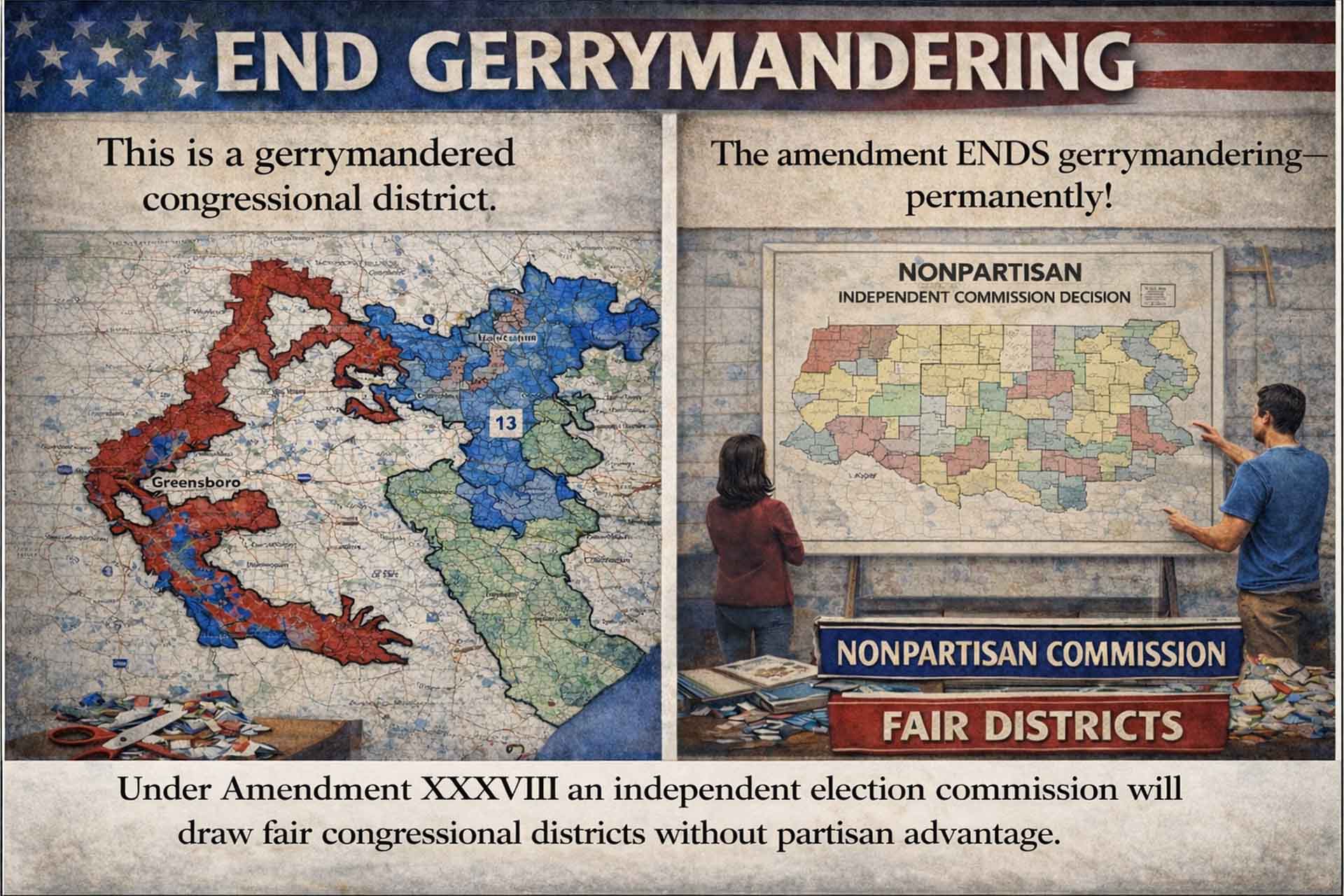
Polls consistently show that about eight out of ten people across the country oppose gerrymandering. Americans do not want politicians choosing their voters. They strongly prefer that voters choose their representatives, with congressional district lines drawn by independent, nonpartisan commissions instead of by whichever party happens to be in power.
This amendment delivers that result. And the change is permanent. It cannot be undone by one party or the other when they happen to hold a majority in Congress.
Every state will be required to use independent, nonpartisan commissions and simple, fair rules when drawing congressional districts, so maps reflect real communities and equal representation, not political advantage.
The operative section, Section 4 of the amendment, is copied below so you can see exactly how it is written.
Section 4. Equal Representation and Federal Districting Standards
(a) Congress and the several States shall, by general law consistent with this Article, ensure the prohibition of partisan gerrymandering of congressional districts.
(1) All such districts shall be drawn by independent and nonpartisan commissions established within each State, using neutral, uniform, transparent, and measurable criteria based on approximately equal population, compactness, contiguity, and respect for existing political and community boundaries, in full compliance with federal law protecting minority voting rights.
(2) All criteria under this Section shall be applied uniformly and neutrally, using objective, non-discriminatory standards, and shall not be employed to favor or disfavor any political party, incumbent, geographic area, or class of voters, and shall not dilute the voting strength of racial, ethnic, or language-minority communities in violation of federal law, nor to engage in geographic, political, or partisan targeting, such that no State, region, or constituency is singled out for adverse treatment.
(b) Each independent redistricting commission established pursuant to this Section shall:
(1) exclude from membership current federal, State, or local elected officials; candidates for such offices; officers of political parties; and any person who is, or has been within the preceding three (3) years, a registered federal or State lobbyist, as further defined by general law;
(2) be constituted so that no political party holds a majority of the seats, and include representation from voters unaffiliated with the two largest political parties, to the extent practicable;
(3) be selected through procedures that are transparent, publicly disclosed in advance, and based on neutral eligibility criteria; and
(4) conduct open public meetings for deliberation on maps, criteria, and public input; conduct other proceedings in public to the maximum extent practicable, while permitting nonpublic sessions for limited purposes consistent with general law; and make draft and final maps, together with supporting data, reasonably accessible to the public in a timely manner.
(c) This Section shall take effect upon ratification of this Article. Each State shall, within one hundred twenty (120) days after ratification, or within such shorter period as is practicable, enact such administrative laws and establish such commissions as are necessary to comply with this Section, including an independent-commission review of existing congressional districts. The redrawing of any districts that do not conform to the requirements of this Section shall be completed as soon as practicable and, absent extraordinary circumstances, in no case later than one hundred eighty (180) days after ratification.
(d) Temporary administrative measures consistent with this Section may be adopted immediately upon ratification to ensure compliance pending enactment of permanent legislation.
(e) Failure to act as required by this Section shall not excuse noncompliance, and no State may conduct congressional redistricting except in conformity with this Section after ratification of this Article.
(f) During the one hundred twenty (120) day period following ratification, no State shall enact, finalize, implement, or place into legal effect any congressional redistricting plan that does not conform to the requirements of this Section. Temporary measures consistent with this Section may be used during this period as necessary to ensure timely elections. All congressional districts drawn or modified after ratification shall conform fully to the requirements of this Section.
(g) If implementation of this Section would require congressional district boundaries to be finalized fewer than ninety (90) days before a regularly scheduled federal general election, the congressional districts in effect immediately prior to ratification may be used for that election only.
(i) Any redistricting plan adopted pursuant to this Section shall take effect for the next regularly scheduled federal election following its adoption, except that it need not be implemented for any election held within ninety (90) days of the plan’s effective date.
(ii) Deadlines established by this Section shall be strictly enforced; however, where a court of competent jurisdiction finds that compliance within a specified period is impossible despite good-faith efforts to comply, such deadline shall be equitably adjusted only to the extent necessary to permit completion of the required action at the earliest practicable date.
(h) This Section shall be subject to judicial enforcement under this Article, and courts of competent jurisdiction may provide appropriate equitable and declaratory relief as necessary to secure compliance.