

Protects Social Security & Medicare
This section is reserved for a detailed explanation of this provision of the People’s Amendment. Final policy language, supporting facts, and implementation details will be added here.
Next steps:
Lowers Taxes on Middle Class
This section is reserved for a detailed explanation of this provision of the People’s Amendment. Final policy language, supporting facts, and implementation details will be added here.
Next steps:
Zero taxes on first $40,000 of income
This section is reserved for a detailed explanation of this provision of the People’s Amendment. Final policy language, supporting facts, and implementation details will be added here.
Next steps:
Reduces Deficits & Balances Budget
This section is reserved for a detailed explanation of this provision of the People’s Amendment. Final policy language, supporting facts, and implementation details will be added here.
Next steps:
Simplifies Tax Filing
This section is reserved for a detailed explanation of this provision of the People’s Amendment. Final policy language, supporting facts, and implementation details will be added here.
Next steps:
Eliminates Government Waste
This section is reserved for a detailed explanation of this provision of the People’s Amendment. Final policy language, supporting facts, and implementation details will be added here.
Next steps:
Requires Term Limits
This section is reserved for a detailed explanation of this provision of the People’s Amendment. Final policy language, supporting facts, and implementation details will be added here.
Next steps:
Ends Dark Money in Politics
This section is reserved for a detailed explanation of this provision of the People’s Amendment. Final policy language, supporting facts, and implementation details will be added here.
Next steps:
Ends Gerrymandering
and Ensures Fair Maps for Every Voter
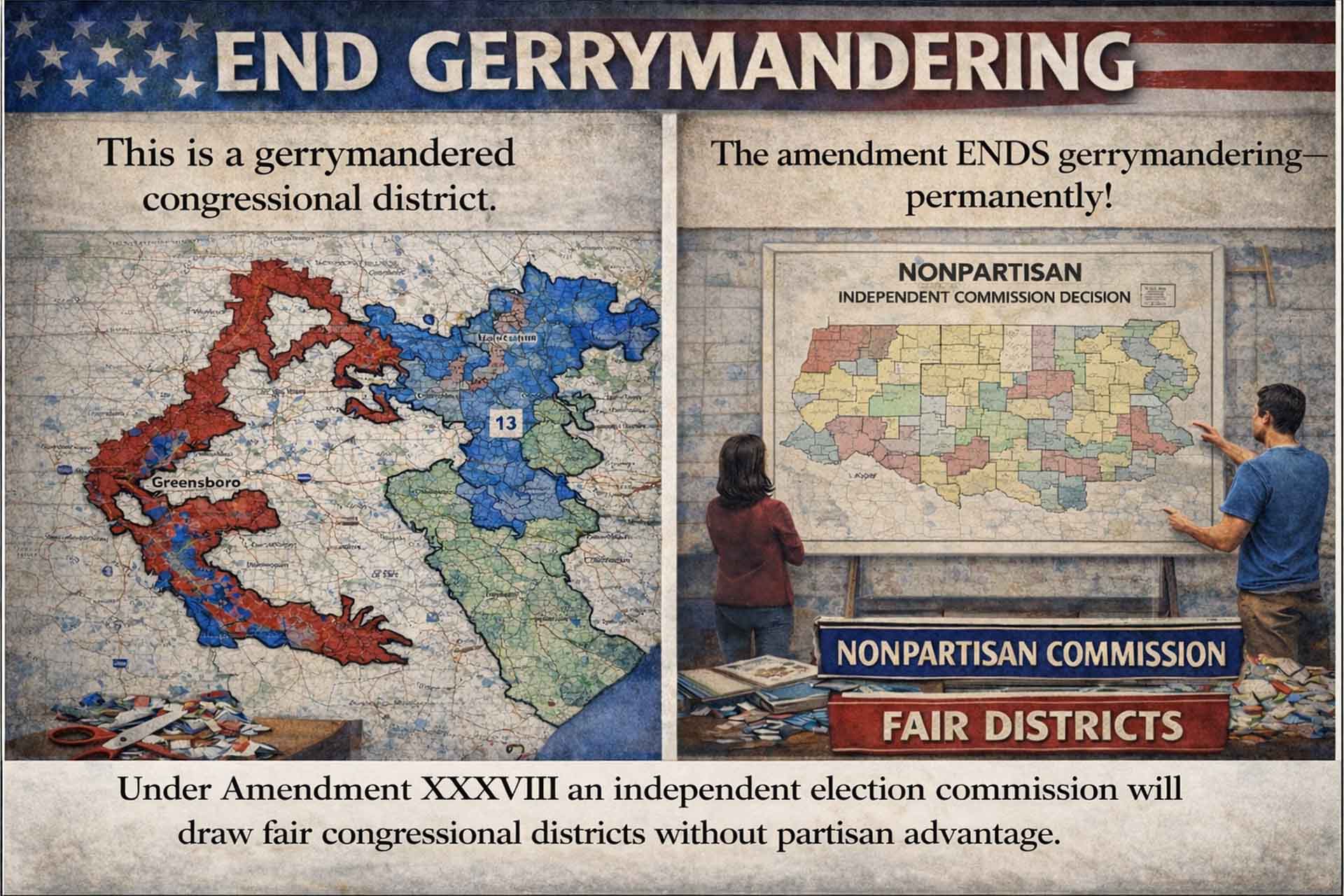
Polls consistently show that about eight out of ten people across the country oppose gerrymandering. Americans do not want politicians choosing their voters. They strongly prefer that voters choose their representatives, with congressional district lines drawn by independent, nonpartisan commissions instead of by whichever party happens to be in power.
This amendment delivers that result. And the change is permanent. It cannot be undone by one party or the other when they happen to hold a majority in Congress.
Every state will be required to use independent, nonpartisan commissions and simple, fair rules when drawing congressional districts, so maps reflect real communities and equal representation, not political advantage.
The operative section, Section 4 of the amendment, is copied below so you can see exactly how it is written.
Section 4. Equal Representation and Federal Districting Standards
(a) Congress and the several States shall, by general law consistent with this Article, ensure the prohibition of partisan gerrymandering of congressional districts.
(1) All such districts shall be drawn by independent and nonpartisan commissions established within each State, using neutral, uniform, transparent, and measurable criteria based on approximately equal population, compactness, contiguity, and respect for existing political and community boundaries, in full compliance with federal law protecting minority voting rights.
(2) All criteria under this Section shall be applied uniformly and neutrally, using objective, non-discriminatory standards, and shall not be employed to favor or disfavor any political party, incumbent, geographic area, or class of voters, and shall not dilute the voting strength of racial, ethnic, or language-minority communities in violation of federal law, nor to engage in geographic, political, or partisan targeting, such that no State, region, or constituency is singled out for adverse treatment.
(b) Each independent redistricting commission established pursuant to this Section shall:
(1) exclude from membership current federal, State, or local elected officials; candidates for such offices; officers of political parties; and any person who is, or has been within the preceding three (3) years, a registered federal or State lobbyist, as further defined by general law;
(2) be constituted so that no political party holds a majority of the seats, and include representation from voters unaffiliated with the two largest political parties, to the extent practicable;
(3) be selected through procedures that are transparent, publicly disclosed in advance, and based on neutral eligibility criteria; and
(4) conduct open public meetings for deliberation on maps, criteria, and public input; conduct other proceedings in public to the maximum extent practicable, while permitting nonpublic sessions for limited purposes consistent with general law; and make draft and final maps, together with supporting data, reasonably accessible to the public in a timely manner.
(c) This Section shall take effect upon ratification of this Article. Each State shall, within one hundred twenty (120) days after ratification, or within such shorter period as is practicable, enact such administrative laws and establish such commissions as are necessary to comply with this Section, including an independent-commission review of existing congressional districts. The redrawing of any districts that do not conform to the requirements of this Section shall be completed as soon as practicable and, absent extraordinary circumstances, in no case later than one hundred eighty (180) days after ratification.
(d) Temporary administrative measures consistent with this Section may be adopted immediately upon ratification to ensure compliance pending enactment of permanent legislation.
(e) Failure to act as required by this Section shall not excuse noncompliance, and no State may conduct congressional redistricting except in conformity with this Section after ratification of this Article.
(f) During the one hundred twenty (120) day period following ratification, no State shall enact, finalize, implement, or place into legal effect any congressional redistricting plan that does not conform to the requirements of this Section. Temporary measures consistent with this Section may be used during this period as necessary to ensure timely elections. All congressional districts drawn or modified after ratification shall conform fully to the requirements of this Section.
(g) If implementation of this Section would require congressional district boundaries to be finalized fewer than ninety (90) days before a regularly scheduled federal general election, the congressional districts in effect immediately prior to ratification may be used for that election only.
(i) Any redistricting plan adopted pursuant to this Section shall take effect for the next regularly scheduled federal election following its adoption, except that it need not be implemented for any election held within ninety (90) days of the plan’s effective date.
(ii) Deadlines established by this Section shall be strictly enforced; however, where a court of competent jurisdiction finds that compliance within a specified period is impossible despite good-faith efforts to comply, such deadline shall be equitably adjusted only to the extent necessary to permit completion of the required action at the earliest practicable date.
(h) This Section shall be subject to judicial enforcement under this Article, and courts of competent jurisdiction may provide appropriate equitable and declaratory relief as necessary to secure compliance.
Next steps:
Creates an Independent Anti-corruption Watchdog
This section is reserved for a detailed explanation of this provision of the People’s Amendment. Final policy language, supporting facts, and implementation details will be added here.
Next steps:
Truth in Congress
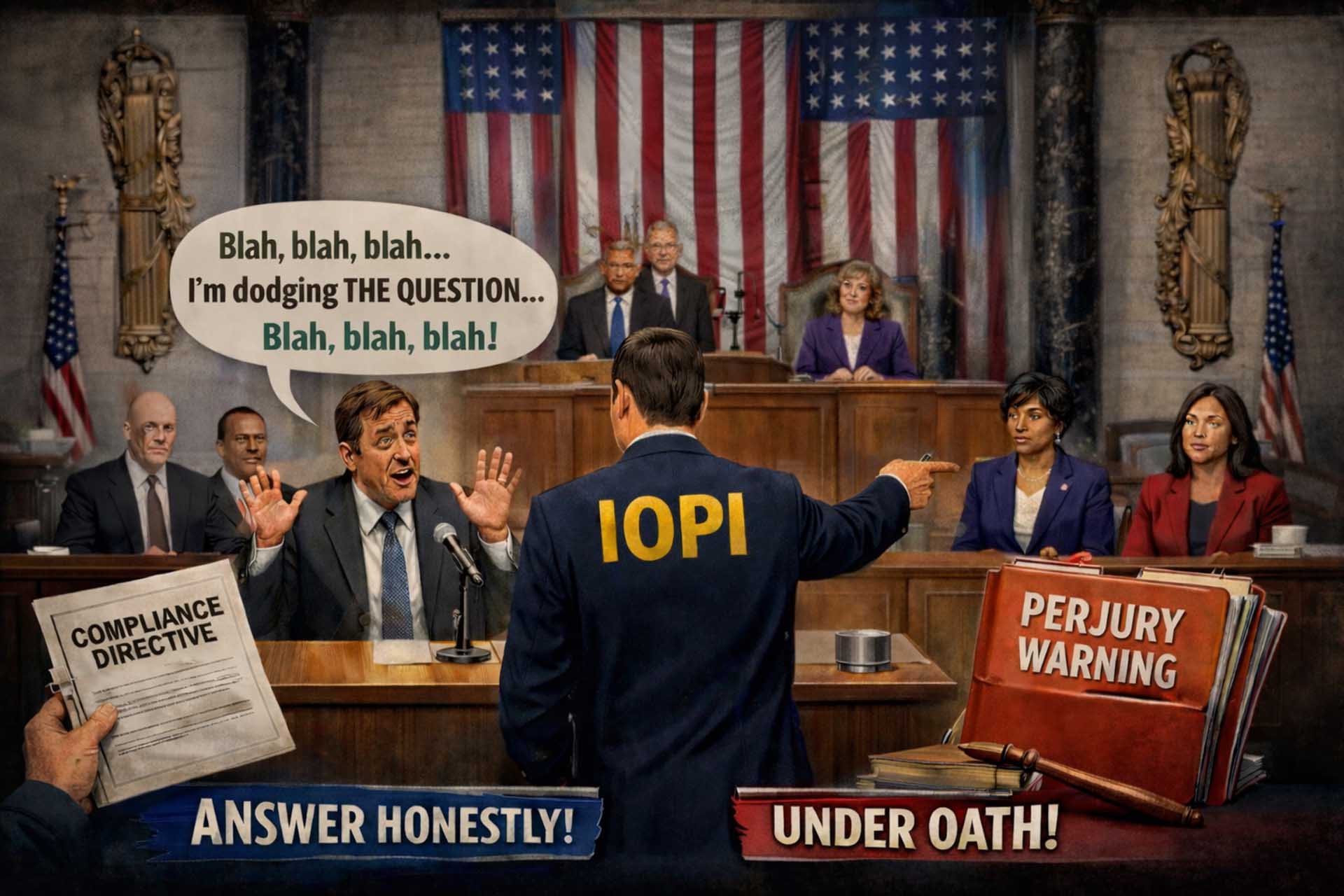
For too long, congressional hearings have produced more theater than truth, leaving the public in the dark. Instead of real answers, we see filibustering, rehearsed talking points, and the familiar “I don’t recall,” even when the questions are simple. That isn’t accountability — and it has eroded public trust across both parties for decades.
Article XXVIII changes this. It creates the Independent Office of Public Integrity (IOPI). And one of its key roles is to ensure that sworn testimony in Congress is truthful, complete, and actually responsive to the questions being asked under oath. Congress will still debate policy and disagree — but dodging honest questions now has real consequences.
An IOPI officer will be present at every hearing where sworn testimony is given, with the authority to demand straight answers, call out evasive or non-responsive testimony, and trigger increasingly serious penalties when a witness refuses to answer truthfully under oath.
This is the honesty in Congress the American People want and deserve, and Article XXVIII delivers it. (See protocols below.)
Protocols for the Independent Office of Public Integrity
Purpose: This protocol establishes procedures for attendance, questioning, compliance directives, and record-keeping when an authorized officer or representative of the Independent Office of Public Integrity (IOPI) attends proceedings of either House of Congress or any committee thereof at which testimony is taken under oath.
I. Appointment and Credentials
- Every IOPI representative assigned to a proceeding:
- Shall be an authorized officer or representative acting within delegated authority
- Shall carry written credentials indicating such authority
- Shall have appropriate security clearance for any classified session attended
- Credentials shall be:
- Presented to the chair upon request
- Recorded in the committee record
II. Attendance Rights
- The IOPI representative shall be permitted to attend any congressional proceeding at which testimony is taken under oath.
- Where testimony is classified, an IOPI representative holding appropriate clearance shall be admitted to the classified portion to the maximum extent permitted by law.
- Any exclusion shall be narrowly tailored and documented on the record to the extent consistent with classification law.
III. Powers of the IOPI Representative
The IOPI representative has authority to:
- Monitor responsiveness of answers
- Request administration of oaths where not yet administered
- Question witnesses directly where permitted by committee rules or Article XXVIII
- Issue verbal notices identifying evasive or non-responsive answers
- Issue written compliance directives where warranted
- Refer matters for civil or criminal enforcement as authorized by Article XXVIII
The representative does not interfere with members’ questioning, time limits, or other matters handled by the Chairperson of the meeting, unless the committee or meeting rules say otherwise.
IV. Responsiveness Requirements
A witness answer is considered noncompliant if it is:
- Evasive
- Misleading
- Non-responsive to the question asked
- Materially incomplete without valid legal justification
Witnesses remain entitled to privileges:
- Fifth Amendment privilege where applicable
- Attorney consultation
- Classification protections
- Other rights under federal law
When such privileges are asserted they must be explicit and shall be on the record.
V. Verbal Notice Procedure
When the representative determines non-responsiveness:
- The representative shall issue a verbal notice stating:
- he precise question asked
- the reason the answer is deficient
- the opportunity to cure the deficiency
- The witness shall be given an immediate and fair opportunity to respond fully.
VI. Written Compliance Directive
If non-responsiveness persists:
- The IOPI representative may issue a written compliance directive
- The directive shall:
- Identify the specific question or questions
- Describe the deficiency
- Set a deadline for responsive answer
- Specify possible enforcement referral for continued noncompliance
- The directive shall be:
- Entered into the public fiscal ledger
- Preserved in the hearing record
VII. Recordkeeping
IOPI shall maintain:
- Audio or stenographic record citations of all directives
- Written justifications for exclusions
- Compliance outcomes
All non-classified portions shall be posted on the public fiscal ledger.
VIII. Enforcement Referral
Where noncompliance persists despite directives, the IOPI officer in attendance may:
- Seek judicial enforcement of subpoenas
- Refer suspected perjury, obstruction, or false statements for criminal prosecution
- Initiate civil enforcement authorized under Article XXVIII
XI. Constitutional Authority is Maintained
Nothing in this protocol shall be construed to diminish the constitutional authority of either House of Congress or their committees to conduct hearings or establish procedural rules.
In Plain Language
An authorized representative of the Independent Office of Public Integrity will attend Congressional hearings to ensure something simple: When witnesses testify under oath, they must tell the truth and actually answer the question.
Creates a Public Transparency Portal
This section is reserved for a detailed explanation of this provision of the People’s Amendment. Final policy language, supporting facts, and implementation details will be added here.
Next steps:
Incentivizes Congress to follow rules
This section is reserved for a detailed explanation of this provision of the People’s Amendment. Final policy language, supporting facts, and implementation details will be added here.
Next steps:
Protects America’s Future Generations
This section is reserved for a detailed explanation of this provision of the People’s Amendment. Final policy language, supporting facts, and implementation details will be added here.
Next steps: