
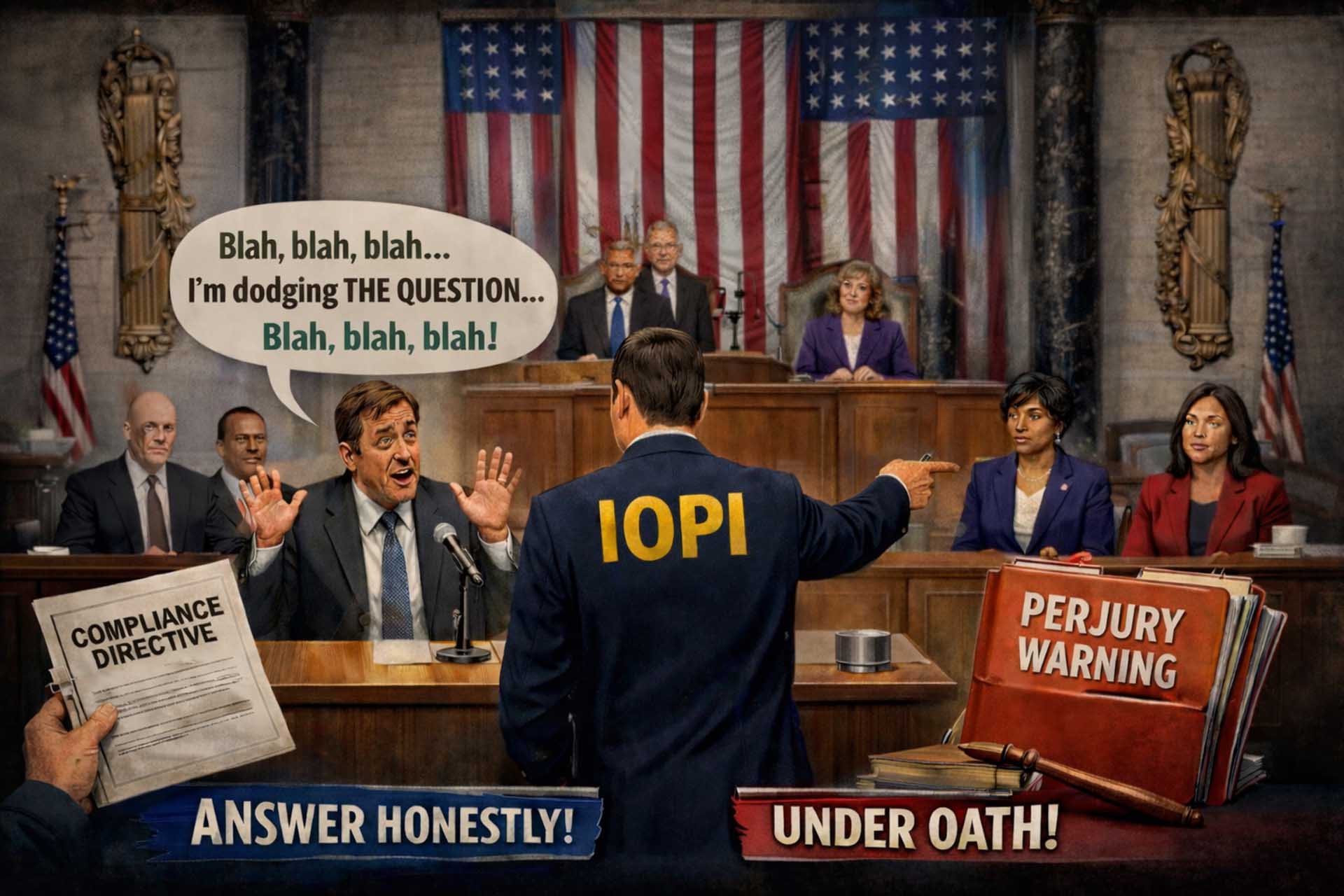
For too long, congressional hearings have produced more theater than truth, leaving the public in the dark. Instead of real answers, we see filibustering, rehearsed talking points, and the familiar “I don’t recall,” even when the questions are simple. That isn’t accountability — and it has eroded public trust across both parties for decades.
Article XXVIII changes this. It creates the Independent Office of Public Integrity (IOPI). And one of its key roles is to ensure that sworn testimony in Congress is truthful, complete, and actually responsive to the questions being asked under oath. Congress will still debate policy and disagree — but dodging honest questions now has real consequences.
An IOPI officer will be present at every hearing where sworn testimony is given, with the authority to demand straight answers, call out evasive or non-responsive testimony, and trigger increasingly serious penalties when a witness refuses to answer truthfully under oath.
This is the honesty in Congress the American People want and deserve, and Article XXVIII delivers it. (See protocols below.)
Protocols for the Independent Office of Public Integrity
Purpose: This protocol establishes procedures for attendance, questioning, compliance directives, and record-keeping when an authorized officer or representative of the Independent Office of Public Integrity (IOPI) attends proceedings of either House of Congress or any committee thereof at which testimony is taken under oath.
I. Appointment and Credentials
- Every IOPI representative assigned to a proceeding:
- Shall be an authorized officer or representative acting within delegated authority
- Shall carry written credentials indicating such authority
- Shall have appropriate security clearance for any classified session attended
- Credentials shall be:
- Presented to the chair upon request
- Recorded in the committee record
II. Attendance Rights
- The IOPI representative shall be permitted to attend any congressional proceeding at which testimony is taken under oath.
- Where testimony is classified, an IOPI representative holding appropriate clearance shall be admitted to the classified portion to the maximum extent permitted by law.
- Any exclusion shall be narrowly tailored and documented on the record to the extent consistent with classification law.
III. Powers of the IOPI Representative
The IOPI representative has authority to:
- Monitor responsiveness of answers
- Request administration of oaths where not yet administered
- Question witnesses directly where permitted by committee rules or Article XXVIII
- Issue verbal notices identifying evasive or non-responsive answers
- Issue written compliance directives where warranted
- Refer matters for civil or criminal enforcement as authorized by Article XXVIII
The representative does not interfere with members’ questioning, time limits, or other matters handled by the Chairperson of the meeting, unless the committee or meeting rules say otherwise.
IV. Responsiveness Requirements
A witness answer is considered noncompliant if it is:
- Evasive
- Misleading
- Non-responsive to the question asked
- Materially incomplete without valid legal justification
Witnesses remain entitled to privileges:
- Fifth Amendment privilege where applicable
- Attorney consultation
- Classification protections
- Other rights under federal law
When such privileges are asserted they must be explicit and shall be on the record.
V. Verbal Notice Procedure
When the representative determines non-responsiveness:
- The representative shall issue a verbal notice stating:
- he precise question asked
- the reason the answer is deficient
- the opportunity to cure the deficiency
- The witness shall be given an immediate and fair opportunity to respond fully.
VI. Written Compliance Directive
If non-responsiveness persists:
- The IOPI representative may issue a written compliance directive
- The directive shall:
- Identify the specific question or questions
- Describe the deficiency
- Set a deadline for responsive answer
- Specify possible enforcement referral for continued noncompliance
- The directive shall be:
- Entered into the public fiscal ledger
- Preserved in the hearing record
VII. Recordkeeping
IOPI shall maintain:
- Audio or stenographic record citations of all directives
- Written justifications for exclusions
- Compliance outcomes
All non-classified portions shall be posted on the public fiscal ledger.
VIII. Enforcement Referral
Where noncompliance persists despite directives, the IOPI officer in attendance may:
- Seek judicial enforcement of subpoenas
- Refer suspected perjury, obstruction, or false statements for criminal prosecution
- Initiate civil enforcement authorized under Article XXVIII
XI. Constitutional Authority is Maintained
Nothing in this protocol shall be construed to diminish the constitutional authority of either House of Congress or their committees to conduct hearings or establish procedural rules.
In Plain Language
An authorized representative of the Independent Office of Public Integrity will attend Congressional hearings to ensure something simple: When witnesses testify under oath, they must tell the truth and actually answer the question.